Those I mentor
I have been aligned with Product Design and visual communication taking care of various modules which include Basic Drawing, Visualisation and representation, Nature and Form, Visual Identity and Branding, Material Exploration, Nature Studies, Object drawings, Model Making, Micro Interaction, and Digital tools. 2D Game Design Artwork, and Character
Design, Visual Storytelling.
Form and space
Aims of the course
This module aims to introduce and enable an understanding of basic understanding of Form, Space, and structure. Students will be able to learn the basics of Shape and form, Principles of Form, radial manipulation, Volume, and Space,
and how all these play a vital role when creating a Structure.
Course Outcomes
-
To understand and define the relationship between forms and the spaces they occupy.
-
Able to develop the ability to discern and establish direct, and indirect connectivity and associations between forms, their visual expression, and perception.
-
To understand the structures and emotive qualities of various forms, spaces, and composite systems.
-
To understand the application of design principles & and visual tools to generate forms with emotive qualities.
-
To be able to learn to craft physical models that appropriately and productively exhibit sensitivity to design principles.
-
To be able to learn to Conceptualize 3D creative interventions contextually.
Students' work


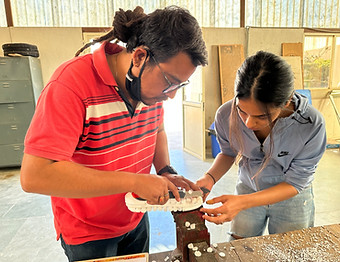

Micro Interactions
Aims of the course
Colour is a critical consideration in design, especially for digital interfaces, as colours play a significant role in conveying information, setting the mood, and visually creating a hierarchy.
The purpose of this course was to make clear the little connections between the students and the principles of physics as well as motions, action, rhythms and pauses, staging, and other fundamental ideas linked to motion. The pupils were instructed on the fundamentals of micro-interaction, and how to incorporate them into their services and goods.
Course Outcomes
-
To clarify the micro-interactions to the students and physics and concepts.
-
Able to learn the movements, action, rhythms and pauses, staging and other elementary understandings related to motion.
-
The students learned the fundamentals of micro-interaction and how to apply them to their goods and services.
Students' work


Introduction to graphic design (PG_sem_II)
Aims of the course
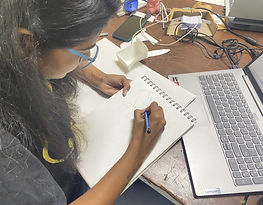
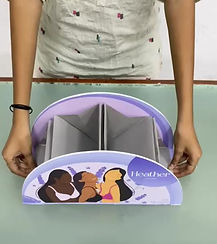
This course explores the principles and practices of visual identity design and branding. Students will learn how to develop a strong visual identity system and apply it to create compelling brand experiences across various media and platforms.
Course Outcomes
-
To be able to learn the Use visual identities in environmental and physical situations.
-
To be able to learn independent visual and contextual research to produce successful branding and identity designs.
-
To be able to recognize and identify or define the key components of brand and visual identity.
-
To be able to learn the consideration the importance of branding and visual identity in social and professional situations.
-
To be able to learn the utilization of branding techniques to facilitate the creation of a brand and a visual identity.
-
To understand the principles and methods of branding in relation to one's own work.
Students' work





Visualisation & Representation
Aims of the course
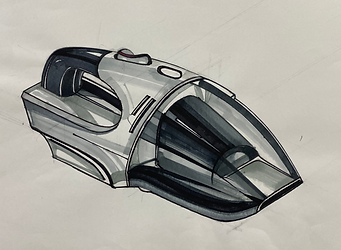
Students learn the process of basic perspective drawing, alcohol marker rendering, object drawing, and their structure. Understanding of color swatch also. They learn how to enhance their sketching skills in this session.
Course Outcomes
-
To demonstrate critical observation skills with the comprehension of ratio, scale, and proportions.
-
To be able to learn techniques to formulate 3D visualization skills.
-
To understand the ability to represent surfaces and volumes, and their spatial interaction through various mediums.
-
To be able to represent a clear, detailed image of their visualized design through the use of standardized technical medium.
-
To be able to consciously make decisions with respect to representing their ideations.
Students' work




Form Studies (Theme – Emotion)
Aims of the course
"Emotion" was the focus of this course. The general objective of a form studies course is to provide students with a solid grounding in the principles of form, shape, and three-dimensional design so they may use these skills creatively in a range of fields and occupations where a solid understanding of form is necessary.
Course Outcomes
-
To understand the Creation of visual appeal and the emotional content of the design. Which product attributes help in the communication of emotions; and how to evoke such emotions through a product.
-
To be able to learn advanced form creation.
-
To understand the Visual tools to create forms and develop to 3D.
-
To be able to learn From transition, understanding the emotion and flow.
Students' work


Material Exploration
Aims of the course
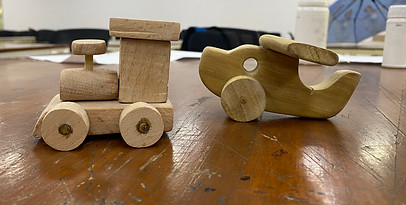
The aim of this course is to develop a sense of volume and space in the form of material exploration. By exploring the various materials, and tools, students learn the skills and precision.
Course Outcomes
-
To understand of the basic properties and applications of the various materials within their categories.
-
To explore material attributes through a series of small-scale physical models.
-
To effectively analyze the applicability of materials based on the explorations and manipulation.
-
To assess and demonstrate methods of appropriate selection and application to their design.
-
To translate their knowledge and develop an end result that exhibits their sensitivity to the visual and perceptual issues involved.
Students' work


.jpeg)
.jpeg)
Visual Identity & Branding (Interaction Design)
Aims of the course
A course on Visual Identity and branding typically aims to provide students with a comprehensive understanding of the principles, strategies, and practical skills involved in creating and managing a strong visual identity for a brand.
Course Outcomes
-
To understand basic design concepts including rhythm, balance, unity, contrast, and focus. Utilize these ideas in real-world design tasks.
-
To understand graphic design tools that are considered industry standards, such as Adobe Creative Suite (Photoshop, Illustrator). To produce and work with photos, graphics, and layouts, use software tools.
-
To Know the basic concepts of typography, such as readability, hierarchy, and font anatomy. In design compositions, use typography to good effect.
-
To learn about the fundamentals of colour theory, such as the colour wheel, colour harmony, and the effects of colour on the mind. Utilise colour theory to produce visually attractive designs.
-
To Learn composition strategies and layout concepts for print and digital media. Make layouts that are aesthetically pleasing and well- organized.
Students' work


© 20323 by Nipan das. copyright all rights reserved